What Did People Really Wear During the Renaissance?
A Guide to Historical Clothing
From elaborate royal garments to the practical clothing of everyday people, Renaissance fashion tells a fascinating story of history, craftsmanship, and personal expression.
When we picture the Renaissance, we often imagine elegant gowns, richly decorated doublets, flowing cloaks, feathered hats, and grand celebrations. These images are familiar from paintings, historical films, and Renaissance festivals. But what did people actually wear during this remarkable period?
The answer is more interesting than you might expect.
Renaissance clothing was far more than a matter of fashion. It reflected a person’s social standing, occupation, wealth, and even the region in which they lived. Clothing could communicate power and prestige, but it also served practical purposes in everyday life.
Let’s explore the fascinating world of Renaissance fashion, from the garments worn by kings and nobles to the clothing of merchants, craftspeople, and ordinary citizens.
The Renaissance: An Era of Changing Fashion
The Renaissance began in Italy during the 14th century and gradually spread across Europe, influencing art, architecture, literature, and fashion. By the 15th and 16th centuries, clothing had become an increasingly important expression of wealth, identity, and social status.
Fashion was not uniform across Europe. Italian styles differed from those in England, France, Germany, and Spain. Trends also changed considerably over the centuries.
Wealthy Europeans could afford luxurious materials, intricate embroidery, and elaborate tailoring. Ordinary people generally wore simpler, more durable clothing made from readily available fabrics.
Yet across social classes, certain garments became defining features of Renaissance dress.
What Did Renaissance Men Wear?
Men’s clothing during the Renaissance was often more colorful, fitted, and elaborate than modern audiences might expect.
The Doublet: The Centerpiece of Men’s Fashion
One of the most recognizable garments of Renaissance men’s fashion was the doublet.
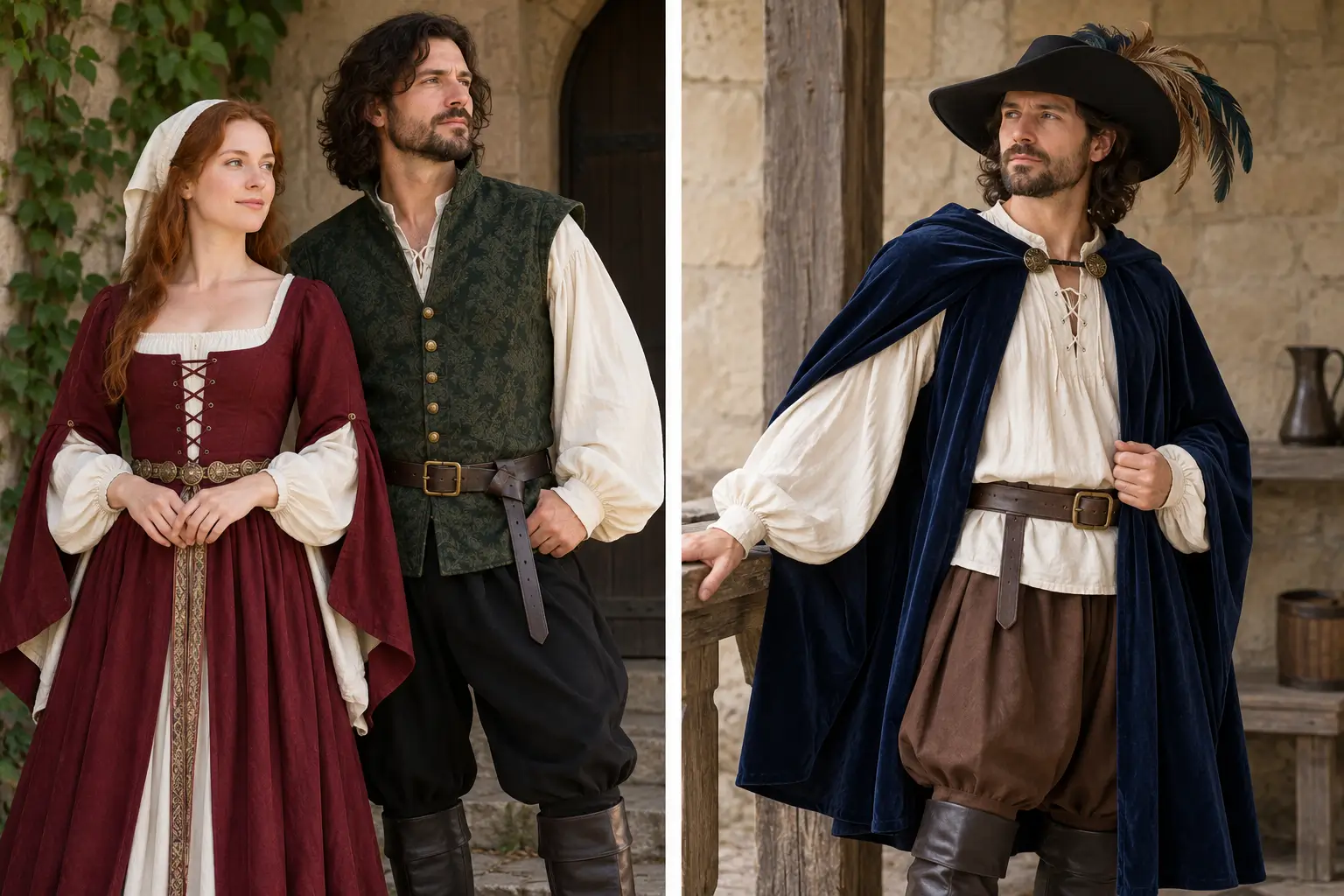
A doublet was a close-fitting upper-body garment, generally worn over a linen shirt. Its design evolved considerably throughout the Renaissance, from relatively simple fitted garments to elaborate styles featuring padding, decorative buttons, slashing, and embroidery.
Among wealthy gentlemen, doublets were frequently made from expensive fabrics such as silk, velvet, or fine wool. More modest versions were worn by merchants, tradesmen, and others who could not afford elaborate clothing.
Doublets were not merely decorative. They helped create the fashionable silhouette of the period and, in some styles, supported or attached to the leg garments worn beneath them.
Today, the doublet remains one of the most distinctive elements of Renaissance-inspired men’s costumes.
The Shirt: An Essential Layer
Beneath the doublet, men typically wore a linen shirt.
Linen was valued because it could be washed more readily than expensive outer garments. Shirts also provided a layer between the skin and heavier clothing.
Depending on the period and social standing of the wearer, shirts might feature gathered fabric, full sleeves, embroidered collars, or decorative cuffs.
The loose, flowing shirts commonly called poet shirts today are inspired by historical styles, although the modern term and many contemporary designs are not exact reproductions of Renaissance garments.
Their generous sleeves and relaxed fit make them popular for Renaissance festivals, theatrical productions, and historical-inspired costumes.
Breeches and Hose: Changing Styles Through the Centuries
Men’s lower-body clothing underwent considerable changes during the Renaissance.
In the earlier part of the period, fitted hose were widely worn, sometimes extending from the waist to the feet. As fashions developed, separate upper and lower leg garments became increasingly common.
By the 16th century, various forms of breeches had become fashionable, particularly among men of higher social standing.
Some were relatively fitted, while others were dramatically padded or gathered to create a fuller silhouette.
These distinctive shapes may seem unusual by modern standards, but they were important expressions of contemporary fashion.
Breeches, paired with a doublet and shirt, remain a familiar combination in Renaissance-inspired clothing.
What Did Renaissance Women Wear?
Women’s fashion during the Renaissance was equally varied and often remarkably elaborate.
Clothing typically consisted of several layers, with the exact combination depending on the period, location, and social standing of the wearer.
Shifts, Gowns, and Bodices
A linen shift or chemise was a fundamental undergarment for many women. Like men’s shirts, it helped protect expensive outer clothing from direct contact with the skin.
Over this, women wore gowns or combinations of fitted upper garments and skirts, depending on local fashion.
Wealthier women might wear gowns made from silk, velvet, brocade, or other costly textiles, often decorated with embroidery, contrasting fabrics, and ornamental details.
The shape of women’s clothing also changed over time. Some fashions emphasized a natural silhouette, while others introduced increasingly structured bodices and elaborate skirts.
The familiar image of the Renaissance lady in a richly decorated gown reflects only one part of a much broader history of women’s dress.
Head Coverings and Bonnets
Headwear was an important part of Renaissance clothing for both practical and social reasons.
Women wore a wide variety of veils, caps, coifs, hoods, and other coverings. Styles differed by region, marital status, occupation, and prevailing fashion.
Simple linen head coverings were particularly useful for keeping hair tidy and protecting it during everyday activities.
More elaborate headwear could demonstrate wealth and social standing.
Today, historical-style bonnets and caps remain popular among reenactors and costume enthusiasts seeking to complete a period-inspired outfit.
Fabrics and Colors: What Was Renaissance Clothing Made From?
One of the most interesting aspects of Renaissance fashion is the variety of materials used.
Linen was widely used for shirts, shifts, and other garments worn close to the body.
Wool was one of the most important textiles in European clothing, ranging from coarse, practical cloth to exceptionally fine and expensive fabrics.
Silk was associated with luxury and was especially prized among wealthy consumers.
Velvet, often woven from silk in the period, was a particularly prestigious textile. Its rich surface and distinctive appearance made it desirable for court clothing and ceremonial garments.
Colors were also important. Renaissance clothing was not limited to the dull browns and greys often associated with historical life.
Red, blue, green, yellow, black, and many other colors appeared in clothing across different social classes.
However, the cost and quality of dyes varied considerably. Some colors and finishes required expensive materials or specialized processes, making them more accessible to wealthy buyers.
Deep, high-quality black fabrics, for example, could be especially costly and fashionable.
Clothing could be both beautiful and highly symbolic.
Cloaks and Capes: Fashion Meets Function
Cloaks were among the most practical and enduring garments of Renaissance Europe.
They provided protection from wind, rain, and cold, while also serving as fashionable outerwear.
A traveler might wear a sturdy wool cloak for warmth, while a wealthy gentleman might choose a finely tailored cloak made from luxurious fabric.
The length, shape, lining, and decoration of a cloak could vary considerably.
Cloaks were also convenient garments because they could be worn over other layers without restricting the underlying clothing as much as some fitted outerwear.
Over time, cloaks and capes became closely associated with dramatic historical figures, from noblemen and courtiers to adventurers and fictional heroes.
Their appeal continues today in Renaissance festivals, historical reenactments, fantasy events, and theatrical costumes.
Did Ordinary People Dress Like Renaissance Nobility?
Not quite.
The elaborate garments preserved in museums and depicted in famous portraits tend to represent wealthier members of society.
Most people could not afford wardrobes filled with expensive velvet, silk, and decorative accessories.
Farmers, laborer’s, servants, and craftspeople needed clothing suited to their daily work.
Practical garments made from linen and wool were common, and clothing was frequently repaired, altered, or passed down.
Even so, ordinary people were not indifferent to appearance. They followed local customs and fashions within their means, and garments could still feature attractive colors, careful tailoring, and decorative details.
Renaissance clothing was not simply divided into magnificent royal outfits and plain peasant garments. There was a broad spectrum of styles, materials, and quality between these extremes.
Hats, Accessories, and the Finishing Touches
No discussion of Renaissance fashion would be complete without accessories.
Men and women wore various forms of headwear, belts, pouches, jewelry, gloves, and other decorative or practical items.
Hats were especially important in men’s fashion. Depending on the period, they could be soft and rounded, structured, brimmed, or decorated with feathers and ornaments.
One familiar style in historical costume collections is the cavalier hat, with its broad brim and dramatic feather decoration.
Although strongly associated with historical dress, the classic cavalier hat belongs primarily to the 17th century, after the height of the Renaissance in many parts of Europe.
It remains a popular choice for later-period historical costumes, musketeer-inspired outfits, and theatrical characters.
Accessories can transform a simple costume into a much more complete and convincing historical-inspired ensemble.
Renaissance Clothing vs. Renaissance Costumes: What’s the Difference?
Modern Renaissance costumes often combine elements from different historical periods.
A costume might feature a 16th-century-inspired doublet, a loose modern poet shirt, later-style breeches, and a 17th-century cavalier hat.
While such combinations may not represent one precise historical decade, they can create an attractive and recognizable historical-inspired appearance.
For serious historical reenactment, accuracy matters. Clothing should be researched according to a specific time, place, and social background.
For Renaissance festivals, theatrical performances, themed celebrations, and fantasy events, there is often greater freedom to combine historical inspiration with personal creativity.
Both approaches have their place.
The important distinction is understanding whether an outfit is intended as a historically accurate reconstruction or a costume inspired by the past.
How to Create Your Own Renaissance-Inspired Outfit
You don’t need a royal wardrobe to capture the spirit of Renaissance fashion.
For a classic men’s Renaissance-inspired look, consider starting with a loose shirt, adding a fitted doublet, and pairing them with breeches.
A cloak can provide another layer of visual interest, while a suitable hat or belt helps complete the appearance.
For a more adventurous character, darker colors, flowing outerwear, and dramatic accessories can create a theatrical or fantasy-inspired interpretation.
For a merchant, traveler, or everyday historical character, simpler fabrics and fewer decorative details may be more appropriate.
The most effective costumes often begin with a few carefully chosen garments that complement one another.
At Artemisia Designs, our collection of Renaissance and historical-inspired clothing includes doublets, breeches, poet shirts, velvet cloaks, bonnets, and accessories designed to help bring these looks to life.
Whether you’re attending your first Renaissance faire, preparing for a theatrical performance, or building a historical-inspired wardrobe, choosing garments that work together is the key to creating a memorable outfit.
Why Renaissance Fashion Still Fascinates Us
Centuries after the Renaissance, its clothing continues to inspire designers, artists, filmmakers, reenactors, and costume enthusiasts.
Perhaps that is because Renaissance fashion was never just about covering the body.
It was about identity, craftsmanship, beauty, and the desire to make an impression.
From the elegant doublet of a courtier to the practical linen garments of an everyday worker, clothing provides a remarkable window into the lives of people who lived hundreds of years ago.
And while today’s Renaissance festivals and historical costumes may take creative liberties, they keep that fascination with the past alive.
Explore the world of historical-inspired clothing at Artemisia Designs, where Renaissance fashion, timeless styles, and a little imagination come together.